
Can Overwearing Contact Lenses Cause Problems with LASIK Surgery?

Many people who consider LASIK are long-time contact lens wearers. Contacts can be a safe and convenient way to correct vision, but overwearing them can create problems for anyone preparing for laser vision correction.
The biggest issue is that LASIK depends on extremely precise measurements of the cornea (the clear front surface of the eye). If contact lenses have temporarily changed the shape, thickness, hydration, or surface quality of the cornea, the LASIK measurements may not reflect the eye’s true natural state.
That does not mean contact lens wearers cannot have LASIK. In most cases, they can. But it does mean that contact lens habits matter, and the eyes need to be healthy and stable before surgery.
What Does “Overwearing” Contact Lenses Mean?
Contact lens overwear can include:
Wearing lenses longer than recommended during the day, sleeping or napping in lenses, stretching monthly or two-week lenses beyond their replacement schedule, wearing lenses despite redness or discomfort, reusing old solution, topping off solution, swimming or showering in contacts, or continuing lens wear when the eyes feel dry, irritated, or blurry.
These habits can stress the cornea and ocular surface. For LASIK, that matters because the laser treatment is planned based on corneal curvature, prescription, corneal thickness, tear film quality, and topography.
Why Contact Lenses Matter Before LASIK
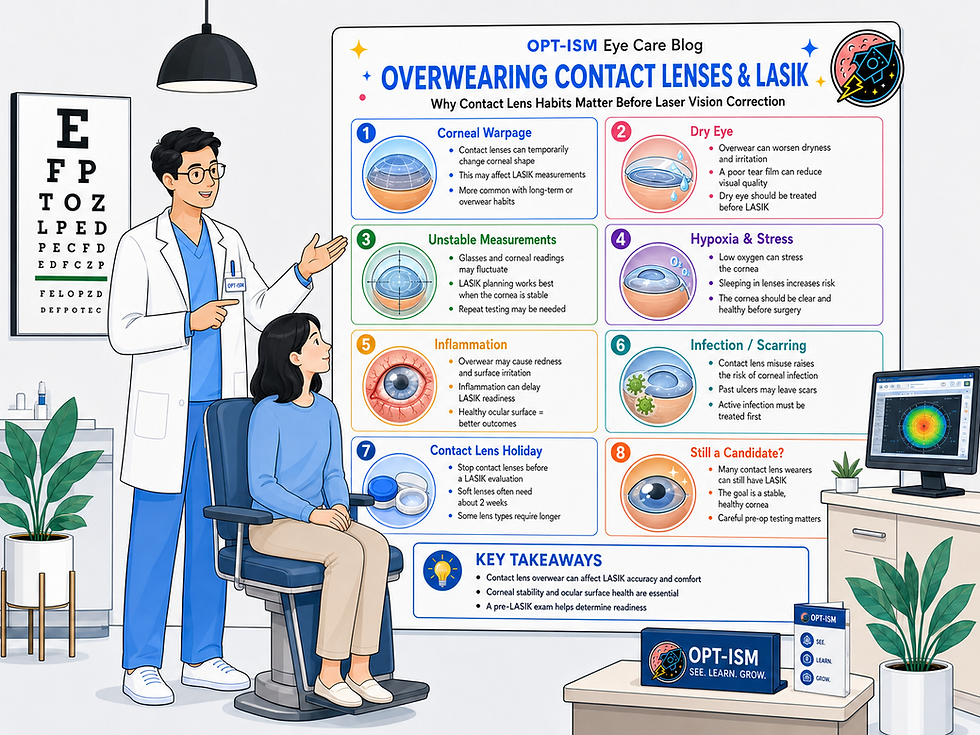
Before LASIK, the surgeon needs to know the true shape and prescription of the eye. Contact lenses sit directly on the cornea, and over time they can temporarily mold or distort the corneal surface. This is called contact lens-induced corneal warpage.
The FDA specifically warns that contact lenses can change the shape of the cornea for several weeks after stopping lens wear. If lenses are not left out long enough before the baseline LASIK evaluation, measurements may be inaccurate, which can lead to a poor surgical plan and poor visual outcome. The FDA recommends stopping soft contact lenses for 2 weeks, toric soft or rigid gas permeable lenses for at least 3 weeks, and hard lenses for at least 4 weeks before the initial LASIK evaluation.
Problem #1: Corneal Warpage Can Make LASIK Measurements Unreliable
Corneal warpage means the cornea has been temporarily reshaped by contact lens wear. This can make the cornea look steeper, flatter, more irregular, or more astigmatic than it really is.
That matters because LASIK corrects vision by reshaping the cornea with a laser. If the preoperative map is distorted, the laser plan may be based on the wrong shape.
A major study by Wang and colleagues looked at 165 consecutive contact lens-wearing patients being evaluated for keratorefractive surgery. Significant contact lens-induced corneal warpage was found in 12% of patients. In those with warpage, stabilization took an average of 7.8 weeks, with a range of 1 to 20 weeks, and recovery time varied by lens type. The authors recommended documenting stable refraction, keratometry, and corneal topography before scheduling refractive surgery.
Another classic study by Wilson and colleagues followed 21 eyes with contact lens-induced corneal warpage using computerized corneal topography. The study found irregular astigmatism, loss of normal corneal symmetry, and in some rigid lens wearers, corneal changes that could simulate early keratoconus. Some rigid lens-related warpage took up to 5 months to stabilize after stopping contact lens wear.
Problem #2: The Prescription May Look Different Than It Really Is
When contact lenses alter corneal shape, the glasses prescription can also shift. A patient may appear to have more or less astigmatism, a different degree of nearsightedness, or fluctuating vision.
This is one reason patients may be asked to return for repeat measurements before LASIK. The goal is not to delay surgery unnecessarily. The goal is to make sure the eye has stopped changing.
At OPT-ISM Eye Care, this is where corneal topography, refraction, tear film evaluation, and ocular surface assessment become important. LASIK should be planned from a stable eye, not an eye temporarily molded by contact lens wear.
Problem #3: Contact Lens Overwear Can Worsen Dry Eye
Dry eye is one of the most important factors to address before LASIK. Contact lens wear itself is considered a relevant risk factor for dry eye, and contact lens discomfort is a major reason patients reduce or discontinue lens wear.
This matters because LASIK can temporarily worsen dry eye symptoms. The ASCRS Cornea Clinical Committee notes that ocular surface disease, especially dry eye disease, can reduce visual quality and affect refractive measurements before refractive surgery. The committee also emphasizes that diagnosing and treating ocular surface disease before surgery can improve postoperative outcomes and patient satisfaction.
Patients who overwear contacts may already have dryness, inflammation, poor tear breakup, corneal staining, or meibomian gland dysfunction. If those issues are present before LASIK, the surgeon may recommend treating the ocular surface first.
Problem #4: Hypoxia and Corneal Stress Can Affect Healing
The cornea needs oxygen. Contact lens overwear, especially sleeping in lenses or wearing lenses that are too tight or too old, can reduce oxygen delivery to the cornea. This can lead to swelling, irritation, inflammation, and in some patients, new blood vessel growth near the cornea.
A study on soft contact lens wear and refractive surgery outcomes notes that soft contact lens-induced corneal edema can increase corneal thickness in response to hypoxia, and long-term soft contact lens wear may affect corneal metabolism, corneal curvature, surface regularity, and preoperative measurements.
For LASIK, the concern is simple: the cornea should be calm, clear, well-oxygenated, and stable before laser treatment.
Problem #5: Infection or Scarring Can Delay or Prevent LASIK
One of the most serious risks of contact lens overwear is microbial keratitis, a corneal infection. Sleeping in contact lenses is one of the highest-risk behaviors.
The CDC reports that sleeping in contact lenses increases the risk of contact lens-related eye infections by six- to eightfold. In a CDC case series, contact lens-related corneal infections associated with sleeping in lenses sometimes required hourly antibiotic drops, multiple follow-up visits, surgical intervention, corneal transplant, or resulted in permanent eye damage.
A past corneal ulcer or infection does not automatically mean LASIK is impossible, but it can leave scarring or irregularity that affects candidacy. Active infection, inflammation, or unexplained corneal haze must be treated before any elective refractive surgery.
Does Contact Lens Wear Automatically Make LASIK Unsafe?
No. Most contact lens wearers can still be excellent LASIK candidates.
The key is that the eyes must be healthy and the measurements must be stable. A 2017 study examining previous soft contact lens wear and corneal refractive surgery outcomes found that prior soft contact lens wear did not negatively affect visual outcomes when patients were appropriately evaluated, including groups who stopped soft lenses before surgery. The same paper also emphasized that refractive surgery outcomes depend on accurate preoperative topography and pachymetry measurements.
So the message is balanced: contact lens wear does not automatically disqualify someone from LASIK, but contact lens overwear can delay surgery or make the preoperative workup less reliable.
How Long Should You Stop Contacts Before a LASIK Evaluation?
A common starting point is:
Soft contact lenses: stop for about 2 weeks before the baseline evaluation.Toric soft lenses or rigid gas permeable lenses: stop for at least 3 weeks.Hard lenses: stop for at least 4 weeks.
These are FDA-listed recommendations, but some patients need longer, especially if they wear toric lenses, multifocal contacts, monovision contacts, scleral lenses, rigid gas permeable lenses, orthokeratology lenses, or have abnormal topography.
The best rule is not simply “wait a certain number of days.” The better rule is: wait until the cornea is stable.
Signs Contact Lens Overwear May Be Affecting Your Eyes
Patients should schedule an eye exam if they notice:
Redness, burning, light sensitivity, fluctuating vision, contact lens discomfort, halos, reduced lens wearing time, mucus discharge, pain, foreign body sensation, or vision that seems worse even with glasses.
These symptoms do not mean LASIK is off the table, but they do mean the ocular surface needs to be evaluated before moving forward.
How to Protect Your LASIK Candidacy
The best steps are simple:
Switch to glasses before your LASIK consultation as directed. Do not sleep in contacts unless specifically prescribed and monitored. Replace lenses on schedule. Avoid swimming or showering in contacts. Treat dry eye, blepharitis, allergies, and meibomian gland dysfunction before surgery. Keep your preoperative appointments and allow repeat measurements if needed.
LASIK is safest and most predictable when the cornea is quiet, healthy, and stable.
Bottom Line
Overwearing contact lenses can cause problems before LASIK by temporarily changing corneal shape, altering prescription measurements, worsening dry eye, increasing inflammation, and raising the risk of corneal infection.
For many patients, these issues are reversible with a contact lens break and proper treatment. The most important step is a thorough pre-LASIK eye evaluation with corneal topography, refraction, tear film assessment, and ocular surface testing.
At OPT-ISM Eye Care in South Tampa, we help patients determine whether their eyes are healthy and stable enough for LASIK consultation, and we can help manage contact lens-related dryness, irritation, or corneal changes before surgery.


Comments