
LASIK and Other Refractive Surgeries: What to Know Before Choosing Vision Correction Surgery

Updated: Jun 5
Glasses and contact lenses work well for many people, but some patients want more freedom from daily vision correction. Refractive surgery is a group of procedures designed to reduce dependence on glasses or contacts by changing how light focuses inside the eye.
LASIK is the best-known option, but it is not the only one. PRK, SMILE, ICL, and refractive lens exchange may also be considered depending on your prescription, corneal shape, eye health, age, lifestyle, and visual goals.

What Is Refractive Surgery?
Refractive surgery is used to correct common vision problems such as nearsightedness, farsightedness, astigmatism, and sometimes age-related near vision changes. These procedures work by either reshaping the cornea, placing a lens inside the eye, or replacing the eye’s natural lens.
The right procedure depends on more than your glasses prescription. A complete eye exam, corneal measurements, tear film evaluation, and discussion of your lifestyle are important before deciding if surgery is a good option.

LASIK: The Most Well-Known Option
LASIK stands for laser-assisted in situ keratomileusis. During LASIK, a thin flap is created on the cornea, and a laser reshapes the tissue underneath to improve how light focuses on the retina. LASIK is commonly used to treat nearsightedness, farsightedness, and astigmatism.
Many patients like LASIK because recovery is often quick, and vision may improve within a short period of time. However, LASIK is not right for everyone. Patients with thin corneas, unstable prescriptions, significant dry eye, certain corneal conditions, or other eye health concerns may not be good candidates.
PRK: A Flap-Free Laser

Vision Option
PRK, or photorefractive keratectomy, is another laser refractive surgery. Like LASIK, PRK reshapes the cornea with a laser, but it does not involve creating a corneal flap. Instead, the surface layer of the cornea is removed and then heals over time.
PRK may be considered for patients who are not ideal LASIK candidates because of corneal thickness, certain lifestyle factors, or occupational needs. The tradeoff is that PRK usually has a longer healing period and more early discomfort compared with LASIK.

SMILE: A Smaller-Incision Laser Procedure
SMILE is a newer laser vision correction procedure used mainly for certain types of nearsightedness and astigmatism. Instead of creating a LASIK-style flap, the laser creates a small piece of tissue within the cornea, which is removed through a small incision. The goal is to reshape the cornea while using a smaller opening than LASIK.
SMILE may be appealing for some patients, but candidacy depends on prescription range, corneal measurements, and surgeon recommendation.

ICL: An Implantable Lens Option
ICL stands for implantable collamer lens. Unlike LASIK, PRK, and SMILE, ICL does not reshape the cornea. Instead, a clear lens is surgically placed inside the eye to help focus vision. ICL may be considered for patients with higher prescriptions or patients who are not ideal candidates for corneal laser surgery.
One important difference is that ICL is an intraocular procedure, meaning the surgery takes place inside the eye. That makes careful screening and follow-up very important.
Refractive Lens Exchange
Refractive lens exchange is similar to cataract surgery, but it is performed before a visually significant cataract is present. The eye’s natural lens is removed and replaced with an artificial intraocular lens. This option may be discussed for patients who are older, have presbyopia, or are looking for a broader range of vision correction than corneal laser surgery can provide.
This procedure is not typically the first choice for younger patients because removing the natural lens changes the eye permanently and carries different risks than corneal laser procedures.
Possible Side Effects and Risks
Refractive surgery can be life-changing for the right patient, but it is still surgery. Possible side effects may include dry eye, glare, halos, starbursts, blurry vision, fluctuating vision, light sensitivity, and difficulty with night driving. The FDA notes that some patients may experience glare, halos, double vision, or reduced quality of vision in low-contrast settings, even if they see well on a standard eye chart.
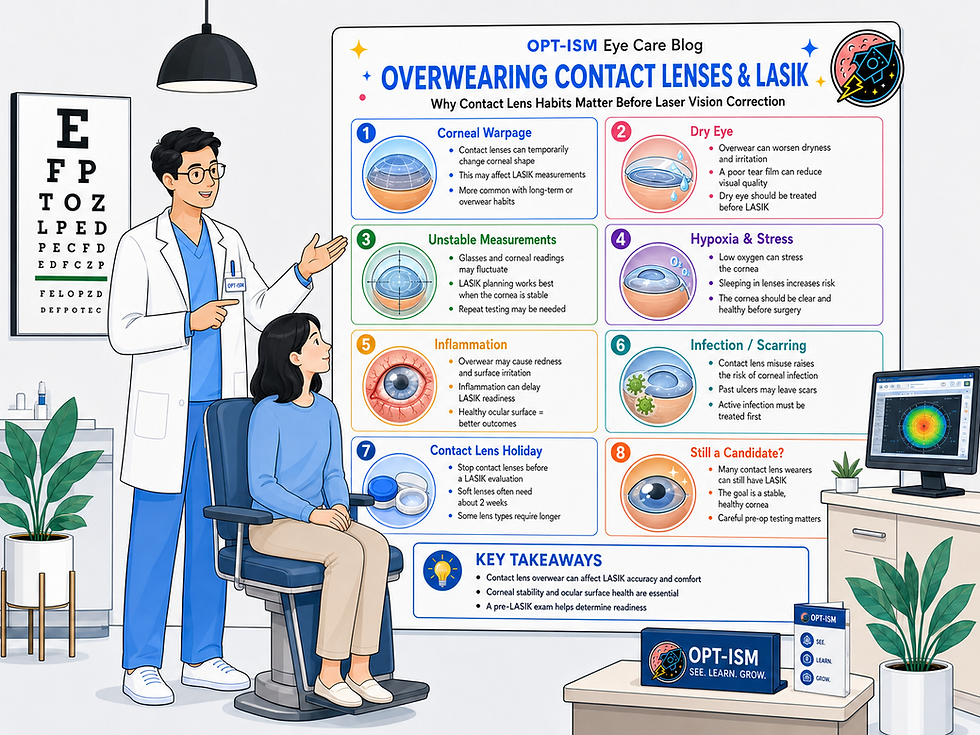
Dry eye is especially important to evaluate before surgery. Patients who already have dry eye, blepharitis, meibomian gland dysfunction, or contact lens intolerance may need treatment before being considered for refractive surgery. The FDA also lists blepharitis as a condition that may increase the risk of infection or inflammation after LASIK.
Who May Not Be a Good Candidate?
Refractive surgery may not be recommended for patients with unstable prescriptions, thin or irregular corneas, keratoconus, uncontrolled dry eye, certain autoimmune conditions, poorly controlled diabetes, active eye infections or inflammation, or unrealistic expectations.
Pregnancy and nursing can also temporarily affect prescription stability and dryness, so surgery is often delayed until the eyes are stable again.
Why a Pre-Surgery Eye Exam Matters
Before considering LASIK or any other refractive surgery, your eye doctor will evaluate several factors, including:
Prescription stability
Corneal thickness and shape
Dry eye and tear film quality
Pupil size
Eye pressure
Retinal health
Contact lens history
Lifestyle and work demands
Night driving concerns
Expectations after surgery
This evaluation helps determine whether surgery is appropriate and which procedure may be safest for your eyes.
Will You Still Need Glasses After Surgery?
Possibly. Refractive surgery can reduce dependence on glasses or contacts, but it does not guarantee perfect vision forever. Some patients may still need glasses for night driving, computer work, reading, or fine detail tasks.
Age also matters. Even after successful distance vision correction, most people eventually develop presbyopia, the age-related loss of near focusing ability. That means reading glasses or another near-vision solution may still be needed later in life.
LASIK vs. PRK vs. SMILE vs. ICL
LASIK is often chosen for fast recovery and convenience. PRK may be better for certain corneas or patients who should avoid a flap. SMILE may be an option for some nearsighted patients who want a small-incision procedure. ICL may be considered for higher prescriptions or patients who are not good candidates for corneal laser surgery.
There is no single “best” refractive surgery for everyone. The best option is the one that fits your eye health, prescription, corneal structure, lifestyle, and long-term visual needs.
Talk With Your Eye Doctor First
If you are interested in LASIK or another refractive surgery, the first step is a comprehensive eye exam. At OPT-ISM, we can evaluate your prescription, eye health, dry eye status, corneal considerations, and visual goals. We can also help you understand whether refractive surgery may be worth exploring and what questions to ask during a surgical consultation.
Refractive surgery can be a great option for many patients, but the safest decisions start with healthy eyes, realistic expectations, and the right testing.

Comments