
Patient friendly Guide to Color Deficiency vs. Color Blindness: What Patients Should Know
- David B. Sabin

- 1 day ago
- 4 min read
Color vision plays an important role in how we experience the world. From reading traffic lights to matching clothes, interpreting charts, or noticing changes in everyday objects, color helps us make sense of our surroundings. But not everyone sees color the same way.
Many people use the term “color blind”, but in most cases, patients are not truly blind to all colors. A more accurate term is often color vision deficiency.
What Is Color Vision Deficiency?
Color vision deficiency means a person has difficulty seeing certain colors or telling some colors apart. The most common type affects the ability to distinguish between red and green shades.
A patient with color deficiency may still see many colors, but certain shades may look dull, similar, or harder to separate. For example, red and green, blue and purple, or orange and brown may be more difficult to tell apart depending on the type of deficiency.

Is Color Deficiency the Same as Being Color Blind?
Not exactly.
Color deficient usually means the patient can see colors, but some colors are harder to distinguish.
Color blind is a broader term that many people use casually. True complete color blindness, where a person sees the world mostly in shades of gray, is very rare.
Most patients who are called “color blind” actually have a partial color vision deficiency, not a complete inability to see color.

Common Types of Color Vision Deficiency
The most common types involve problems with red-green color perception.
Red-Green Color Deficiency
This is the most common form. Patients may have trouble telling the difference between:
Red and green
Green and brown
Blue and purple
Pink and gray
Orange and red
This type is often inherited and is more common in males.
Blue-Yellow Color Deficiency
This type is less common. Patients may have difficulty telling the difference between:
Blue and green
Yellow and pink
Purple and red
Blue-yellow color deficiency can be inherited, but it may also occur with certain eye diseases, optic nerve problems, or medication-related changes.
Complete Color Blindness
Complete color blindness is rare. Patients may see very little color or mostly shades of gray. This can also be associated with reduced vision, light sensitivity, or other eye symptoms.

What Causes Color Vision Deficiency?
Color vision depends on special cells in the retina called cones. These cones help detect different wavelengths of light. When one type of cone does not work normally, certain colors become harder to recognize.
Color vision deficiency may be:
Inherited: Many patients are born with it. It often runs in families and may be noticed during childhood.
Acquired: Some patients develop color vision changes later in life due to eye disease, optic nerve conditions, certain medications, trauma, or neurological problems.
When Should Color Vision Changes Be Checked?
A lifelong color deficiency is often stable and not dangerous. However, a new change in color vision should be evaluated.
Patients should schedule an eye exam if they notice:
Colors suddenly look faded or washed out
One eye sees colors differently than the other
Red looks less bright in one eye
Vision is blurry or dim along with color changes
Color changes occur with headaches, eye pain, or vision loss
New color vision changes can sometimes be related to problems with the retina, macula, optic nerve, or brain pathways.

How Do Eye Doctors Test for Color Deficiency?
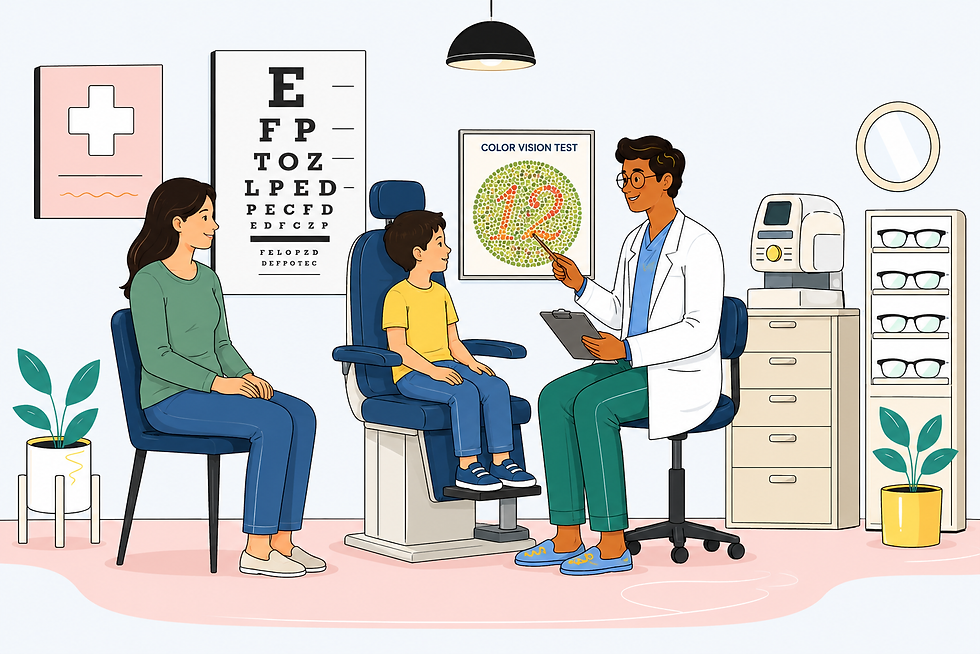
Eye doctors can perform color vision testing during a comprehensive eye exam. A common screening test uses colored dot patterns with hidden numbers or shapes. Patients with certain types of color deficiency may have trouble seeing the number inside the pattern.
Additional testing may be recommended if the color vision change is new, one-sided, or associated with other symptoms.
Depending on the situation, the eye doctor may also evaluate:
Visual acuity
Retina and macula health
Optic nerve appearance
Visual field testing
OCT imaging
Medication history
Neurological symptoms
Can Color Vision Deficiency Be Treated?
Inherited color vision deficiency usually cannot be cured, but many patients learn strategies to manage it well.
Helpful tools may include:
Labeling colors on clothing or supplies
Using apps that identify colors
Relying on position, brightness, or labels instead of color alone
Choosing high-contrast materials
Asking about color-enhancing lenses, when appropriate
For acquired color vision problems, treatment depends on the underlying cause. That is why a new color vision change should be checked by an eye doctor.

Why Color Vision Testing Matters
Color vision testing can be helpful for school, work, safety, and certain careers. Some jobs require accurate color recognition, including positions in aviation, electrical work, design, medicine, transportation, and laboratory settings.
For children, identifying color deficiency early can help teachers and parents avoid relying only on color-based instructions in school.
Schedule a Comprehensive Eye Exam
If you or your child has trouble telling colors apart, or if colors suddenly look different than before, a comprehensive eye exam can help determine whether it is a lifelong color deficiency or a new medical concern.
At OPT-ISM, we evaluate vision, eye health, and symptoms that may affect how patients see the world — including color vision changes.


Comments