
Multifocal Contact Lenses vs. Monovision: Which Contact Lens Fitting Is Right for You?

As we get older, many people notice that reading small print, checking a phone, or seeing up close becomes harder. This common focusing change is called presbyopia, and it usually becomes noticeable around age 40. Contact lenses can often help reduce the need for reading glasses, but the right solution depends on your eyes, your prescription, your work, and your lifestyle. The American Optometric Association and American Academy of Ophthalmology both list multifocal contacts and monovision contacts as common treatment options for presbyopia.
At OPT-ISM, contact lens fittings are customized because there is no one-size-fits-all answer. Some patients do best with multifocal contact lenses, while others prefer monovision or a blended approach.
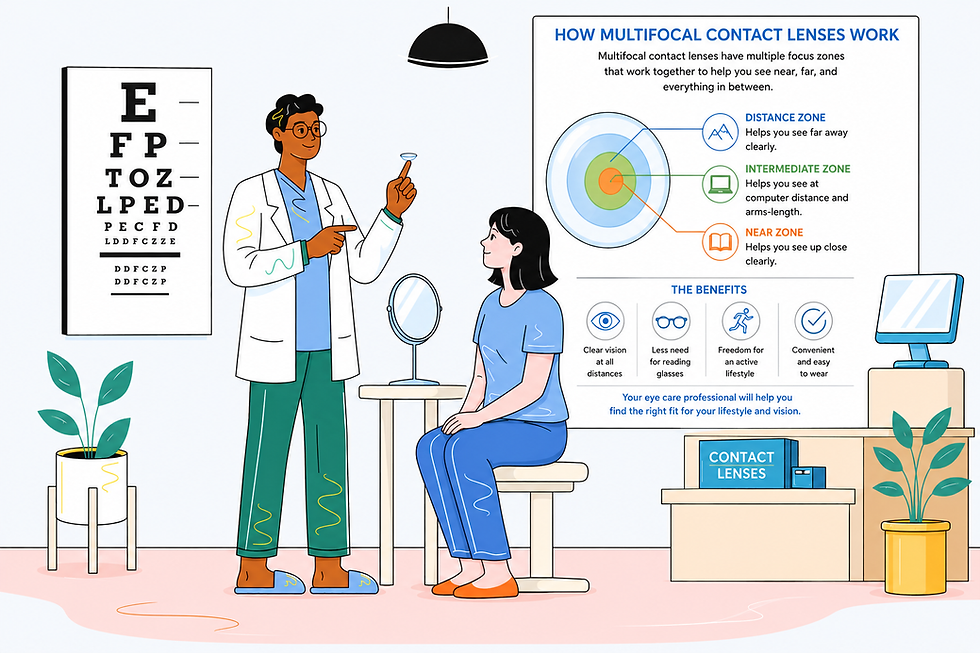
What Are Multifocal Contact Lenses?
Multifocal contact lenses are designed with more than one prescription power in the same lens. Instead of correcting only distance vision, they help your eyes manage distance, intermediate, and near vision.
This can be helpful for everyday tasks such as:
Driving
Working on a computer
Reading text messages
Looking at menus
Moving between near and far tasks throughout the day
Multifocal contacts are often a good option for patients who want more freedom from reading glasses. They may not make every distance perfectly sharp all the time, but many patients enjoy the convenience of being able to function comfortably without constantly reaching for readers.
What Is Monovision?
Monovision is a contact lens fitting method where one eye is corrected mainly for distance and the other eye is corrected more for near vision. Your brain learns to use the eye that gives the clearest image depending on what you are looking at.
For example, one eye may help more with driving or looking across the room, while the other helps more with reading or phone use. The AAO describes monovision as an option that may take some adaptation because the eyes are not being corrected the same way.
Monovision can work very well for some patients, but it is not ideal for everyone. Some people notice changes in depth perception, night driving comfort, or overall balance between the two eyes.
Multifocal Contacts vs. Monovision: What Is the Difference?
The main difference is how the eyes work together.
With multifocal contact lenses, both eyes usually receive lenses designed to help with multiple distances. This allows the two eyes to continue working together more naturally.
With monovision, each eye has a different job. One eye is more distance-focused, and the other is more near-focused.
Neither option is automatically “better.” The best choice depends on your visual goals, your prescription, your eye dominance, your tear film, and how well your brain adapts to each type of correction.
Who May Like Multifocal Contact Lenses?
Multifocal contacts may be a good fit if you:
Want to reduce dependence on reading glasses
Spend a lot of time switching between computer, phone, and distance vision
Prefer both eyes working together at multiple distances
Have an active lifestyle
Already wear contacts and are starting to need readers over them
Want a more natural balance between the two eyes
Patients should know that multifocal contacts sometimes involve a tradeoff. Vision may feel very functional overall, but not always as crisp as single-vision distance contacts or dedicated reading glasses for every task.
Who May Like Monovision Contacts?
Monovision may be a good fit if you:
Want a simpler contact lens setup
Have tried multifocals and did not love them
Mainly need help with phone, menus, or quick reading tasks
Adapt well when one eye is clearer for distance and the other is clearer for near
Do not have high depth-perception demands for work or hobbies
Some patients love monovision because it feels simple and effective. Others feel unbalanced or notice reduced depth perception. That is why a trial fitting is so important.
What Is Modified Monovision?
Some patients benefit from a hybrid approach called modified monovision. This may involve using a multifocal lens in one or both eyes while slightly favoring distance in one eye and near vision in the other. The AOA describes modified monovision as a strategy where the dominant eye may be optimized more for distance and the non-dominant eye more for near.
This approach can be helpful when standard multifocals are close but need a little fine-tuning.
Why the Contact Lens Fitting Matters
A multifocal or monovision contact lens fitting is more detailed than a basic contact lens exam. Your optometrist may evaluate:
Your distance prescription
Your near vision needs
Eye dominance
Astigmatism
Tear film and dry eye symptoms
Lens movement and comfort
Your work habits and screen use
Driving needs, especially at night
How your vision feels in real-world situations
It is common to need adjustments. A contact lens trial may feel good in the exam room, but your true test is how your vision performs during your normal day.
What to Expect During the Adaptation Period
Both multifocal and monovision contacts can take time to adjust to. Your brain has to learn how to process the new visual system.
During the first few days or weeks, some patients may notice:
Slight blur at certain distances
Mild glare or halos
Needing more light to read
Vision that improves as the day goes on
Better comfort after small prescription adjustments
This does not always mean the lenses are wrong. It may mean your eyes and brain are adapting, or that the lens power needs to be refined.
Are Reading Glasses Still Needed?
Sometimes, yes. Even with a successful multifocal or monovision fit, you may still want light readers for very small print, dim lighting, or long periods of detailed near work.
The goal is not always to eliminate glasses 100% of the time. For many patients, the goal is to be less dependent on reading glasses and more comfortable throughout the day.
Which Option Is Best for You?
The best contact lens option depends on your lifestyle.
If you want both eyes working together and you move between distance, computer, and phone tasks all day, multifocal contacts may be a strong starting point.
If you want a simple near-and-distance setup and adapt well to one eye doing more near work, monovision may be worth trying.
If neither feels perfect, a modified monovision approach may help create a better balance.
Schedule a Contact Lens Fitting at OPT-ISM
If reading up close has become harder or you are tired of reaching for readers, multifocal or monovision contact lenses may help. At OPT-ISM, we take the time to understand how you use your vision every day so we can recommend a contact lens fitting that matches your eyes and lifestyle.
Schedule a contact lens exam at OPT-ISM in South Tampa to find out whether multifocal contacts, monovision, or another option is right for you.


Comments